Future of iPad?

Very bright, if you believe iSuppli analyst Rhoda Alexander.

The iPad will account for an overwhelming 74.1 percent of global tablet shipments in 2010, with the remaining 25.9 percent consisting of a mix of older PC-type tablet products and competitive slates. Despite the arrival of the first real iPad competitors in 2011, Apple still will maintain a prevailing 70.4 percent share of shipments, iPad research from iSuppli bears out.  Even in 2012, the iPad will continue to control nearly two-thirds of shipments, at 61.7 percent, as the competition strives to develop ecosystems of tablet apps and content that can match up with those of Apple.

The most likely competitor to the iPad will be HP’s ‘PalmPad’, running on webOS. However, it would not be available until sometime in 2011. Also, Google has to make its ChromeOS ‘touch-enabled’, which it is not at present.

In, addition, “Competitors face some serious obstacles in their efforts to match the total iPad package, most notably competing with the growing suite of iPad-specific applications,” Alexander said.

This challenges the assessment of Acer’s Chairman JT Wang that the iPad’s market share will drop to about 20 percent, maybe less, in the near future.

I tend to believe Ms. Alexander. Matt Burns gives a reasoned analysis at the CrunchGear blog: “Did the iPad prëmptively kill the US tablet market like the Kindle and Nook killed other ebook readers?

iPhones at Target?

Well, old ones.

Target has started a program where you can trade-in your old iPhone.

Apple fanboy’s dream car?

Don’t compute and drive

.

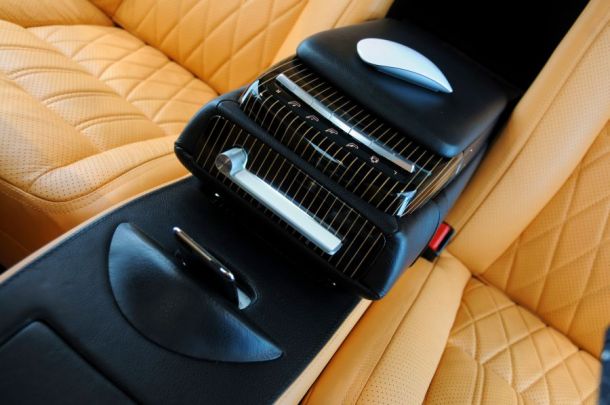
Of course, if you can afford this Mercedes-Benz S600, you must be having a chauffeur. To order, contact ZerCustoms.

The appleblog.com gives the details: “Each car comes packed to the gills with outstanding multimedia capabilities, including two iPads in the rear seats with matching Bluetooth keyboards for each. The iPads are capable of controlling every aspect of the S600′s COMAND system, including the radio, navigation system and telephone, in addition to BRABUS’ own custom multimedia functions. Don’t think you’ll be limited to offline or 3G use, either, because the car boasts its own wireless internet via UMTS and HSDPA connections.

As if that wasn’t enough, there’s also a Mac mini in the back seat that uses a drop-down 15.2-inch TFT display, Magic Mouse and USB 2.0 ports accessible to both passengers for real computing power. Finally, because you wouldn’t want to use iTunes on the Mac mini or the iPod apps on your two iPads, there’s a 64GB iPod touch in the center console that also controls the whole shebang using a custom BRABUS iOS application“.

More pictures to whet your appetite for this baby:

What Is It About 20-Somethings?

Why are so many people in their 20s taking so long to grow up? Read this if you want to know the answer.

BEWARE, it is a 10-page article in the NY Times Magazine; take this exercise when you have some time to spare.

BTW, the link was email to me by my daughter; she’s 22!

Coup d’état in Pakistan soon?

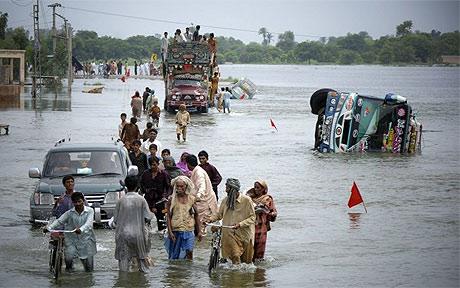
Flood survivors at Muzaffargarh, in central Pakistan, on August 19 Photo: Khalid Tanveer

.

It appears that a military takeover is imminent in Pakistan, as M.J. Akbar has reasoned in this blog post.

Nero fiddled while Rome burnt; Zardari was frolicking in Europe while Pakistan flooded.

President Kayani?

.

UPDATE: The Daily Telegraph reports (on 2010/08/25) that Pakistan’s floods have left a country that’s too difficult to rule; the government in Islamabad is floundering and ripe for a coup – if anyone wanted to launch one, says its op-ed columnist Con Coughlin.

Being evil?

Jason Hiner tells us The dirty little secret about Google Android: Google’s “…Android is enabling the U.S. wireless carriers to exert too much control over the devices and keep the U.S. mobile market in a balkanized state of affairs…

This is because “The carriers and handset makers can do anything they want with it. Unfortunately, that now includes loading lots of their own crapware onto these Android devices, using marketing schemes that confuse buyers (see the Samsung Galaxy S), and nickle-and-diming customers with added fees to run certain apps such as tethering, GPS navigation, and mobile video.

This is very much unlike Apple that took control of technical follow through from AT&T, and this is very likely the reason it had to have an exclusive with just one carrier at the iPhone launch in 2007. For example, Apple refused to throttle data speeds so the users cannot watch YouTube. All wireless carriers, and not just AT&T, disable hardware features on handsets all the time, so that the data demand remains low and not tax their underdeveloped infrastructure; in fact, Verizon is the worst. This assertiveness by Apple has proved to enhance user experience with the iPhone.

Google, however, has no such concerns. Customer experience is not its business model to make money. Its main revenue source is advertisements and all it wants is as many eyeballs as it can garner, whether it means giving the license to use Android for free to OEMs and letting them tweak it, or giving a free rein to wireless carriers to disable any features they want.

The Google-Verizon deal on net-neutrality should be looked in this light as well. If the “Voogle” understanding prevails, the wireless access to the Internet by mobile devices will have two tiers of service, the classification of which will be controlled by the telecom carriers. If a company pays a certain fee, or shares advertisement dollars, the carrier will let that company’s site be accessed at a faster speed. Smaller companies will less money to spare and common users without money, who do not have any such restriction now, will have their websites and blogs load at a much slower pace.

Google and the carriers know that the next big thing is mobile computing. The search giant has a lot of money to throw around and share, and will get preferential treatment. The faster Google sites, like YouTube, load, the user will have a better experience and is more likely to revisit them over others that load slowly. Google wins with being able to generate more ad revenue, and more dollars to share with the carriers. For Google and the carriers, it’s a virtuous cycle.

The sad part is that it is us users who will be at a loss. The breath of fresh air that Apple brought with having a tight control over the hardware and software of the iPhone will be lost pretty soon. We will once again become worse than a third-world nation regarding telecom services. We already pay more per user for the third-class services than any other nation in the world; we’ll be paying even more without any significant improvement in resources.

Future of Android?

While the iPhone OS (iOS) has been dominant for a while, Android recently surpassed it in the US and globally.

Is this good news for Google? Yes and no.

.

Apple has introduced one phone a year for the last 4, and at any time, it offers 3 flavors: 16 and 32 GB versions of the current model, and one lower GB version of last year’s. Apple makes both the hardware and software of the device, and tightly controls software by 3rd parties.

Google, on the other hand, only supplies the OS (for free) to any OEM (Original Equipment Manufacturer) who wants it, and has little, if any, control on software by 3rd parties. Consequently, there are numerous flavors to choose from for an Android handset. This is why Android is outpacing the iOS in the number of devices installed. It won’t be long before it becomes the dominant platform for mobile phones, just like Windows once was.

.

However, there is bad news for the future of Android.

Firstly, since OEMs are allowed to tweak the OS to their liking, there will be OS fragmentation because different makers would like to differentiate their device from the competition.

Secondly, different Android devices may have different versions of the OS (1.6, 2.0, 2.1, 2.2), and the path to upgrade to the latest version will be different for different manufacturers and will be dictated by them, as well. This has led to further OS fragmentation.

How does it matter? Well, any software (app) written for an OS works the best if it is written for a particular version of that OS. Certainly, it can be programmed to be backwards compatible but then it would lose some of the optimization for a later version it was primarily intended to work with.

In addition, if an app is written for one particular version of the OS running on one particular device (hardware) will be the most optimal in function. If and app written for a particular OS version for several different devices will not be as good. It would be worse if an app is written to work on several OS versions running on several different devices by different vendors.

In other words, Apple has the best of all worlds: one device, one manufacturer and one OS version at a time. Certainly, there is some fragmentation of the iOS (a user with an older model may not choose to, or be unable to, upgrade to the latest version), but it is not as bad as Android. Google, on the other hand, has the worst of all options: several devices, several manufacturers and several OS versions at the same time.

In addition to the quality of apps produced for the OS, any software designer will prefer to make money by making only one version of the app, like for the iPhone; he/she will have to make several versions to run on different versions of the Android to make the same money.

As a device user, I’d like to have the latest version of the OS as soon as it is available. I’d be rather upset that I cannot upgrade to the current version of the OS because of my hardware or the OEM would not allow it. I’d be very irked to see another person sporting a similar gadget with the latest version of the OS.

Finally, there are rumors of a Google-Verizon tablet that will run on the Chrome OS. This will lead to even more OS fragmentation of Google’s mobile devices; developers who write several versions of the same app for the Android OS that powers the mobile handsets (different OS versions, different OEMs), will now have to write a totally different app to run on a Chrome based tablet.

.

It is a bit perplexing why Google is following this model. Apple has only one iOS for both its phone and tablet, and therefore has a single App Store. True, all of the 250,000 iPhone apps do not look great on an iPad, but you still can use them. While there are apps exclusive to the iPad, there are many more that are scalable to both the iPhone and iPad displays (universal apps). Google on the other hand, has two ‘App Stores’: an Android Market and a Chrome Market (announced to open later this year).

It could be that Google’s decision to put Chrome on its rumored tablet is because of the recent suit by Oracle: “In developing Android, Google knowingly, directly, and repeatedly infringed Oracle’s Java-related intellectual property” an Oracle spokesperson said in a statement. “This lawsuit seeks appropriate remedies for their infringement.”

If Oracle prevails, it could mean the end of Android, as “Google makes heavy use of Java in the Android software development kit (SDK). Third-party developers code Android apps in Java, which is then translated into bytecode that runs in Dalvik, Google’s own custom VM Virtual Machine).Google’s sole purpose of creating Dalvik was to route around Sun’s IP-based licensing restrictions on Java ME.

Android could be cast away like a hot potato by Google, like Microsoft ditched the Windows Mobile platform!

.

There is more bad news for Android. The three most profitable cellphone makers are Apple, RIM and Nokia. They also have their own OS and would not likely use Android in their handsets. So the OS is left to be picked up by manufacturers like Samsung, LG, Motorola and HTC. While they make a lot of phones, their profit margins are very thin.

This chart is courtesy of another blog, asymco. The article, ‘Android Pursuit of the Biggest Losers‘, is very well written and worth a read.

In three years, RIM and Apple now have increased their EBIT (Earnings Before Interest and Taxes) from 6% to 17% and 1% to 48%, respectively, of the share among the top 7 mobile vendors. This was at the expense of Nokia, mainly. What is quite interesting is that all the prospective Android (and Windows 7) manufacturers share the humble pie of the remaining 13% of the EBIT.

Something to think about.

.

UPDATE: A good explanation of why “its time to end the forced use custom skins” by different OEMs (Motoblur, Sense), and why “the fragmentation of UIs slows Android upgrades and removes customer choice”.

Droid-gate?

The well-hyped ‘iPhone’ killer, Droid 2, has been in the market for only a few days. Already, there are reports of it losing it signal even without holding it!

This seems worse than the iPhone 4 ‘Antennagate’, where you had to hold the phone in a certain way (death grip) to see a drop in signal strength.

It is interesting to remember what Sanjay Jha, Motorola’s co-CEO, said recently when reacting to Apple’s woes: “While the whole industry has to deal with phones being held in different ways, it is disingenuous to suggest that all phones perform equally. In our own testing we have found that Droid X performs much better than iPhone4 when held by consumers”.

At least he was honest; Droid 2 goes to 1 and 0 bars just sitting on a table, randomly.

It seems that everyone is trying to copy the iPhone, warts and all!

Whither Kashmir?

It is interesting to read M.J. Akbar’s column to realize that “Pakistan pre-empted a peaceful settlement in 1948 by organizing an invasion thinly disguised as an “uprising”, in October 1947″.

This was because “A little after Partition [in August 1947], Nehru wrote to Mountbatten that the best time for discussions on the future of Kashmir would be after the spring thaw of 1948 since his government was overburdened by the bitter aftermath of riots and resettlement.”

“If Pakistan had not sought to seize Kashmir through war, the Kashmir problem would have been resolved across a table in 1948”, says Mr. Akbar. He concludes that “The war that Pakistan began is a recipe for disaster; the negotiations that Nehru and Mountbatten wanted are still the only option”.

Pakistani floods and aid?

Suffering its worst flood in 80 years, one-fifth of Pakistan is under water. The numbers of people affected are more than by the Indian tsunami in 2004: about 14 million affected, almost 2 million displaced, and over 1600 dead. (Video 1, Video 2)

The flood has also revealed the crisis in the country’s leadership. For one, the civilian government is weak and its writ doesn’t apply to almost half of the state. The real power lies with the armed forces, notably in foreign policy (especially when it comes to India). And yes, there are large pockets where the only authority is the Taliban.

Almost a failed state (number ten in Foreign Policy ‘Failed State Index 2010‘), the latest calamity will further devastate Pakistan’s economy. This is very disconcerting. Our prayers are with the people who are suffering.

.

However, the international aid fails to flow. Partly, it is an unease among western donors. The US alone has poured over $10 billion during the last decade, and there is not much to show for it. A lot of the money, given to Pakistan for any reason, finds its way to the Army which builds buildings and purchases weapons for use against its arch-enemy, India. There is no guarantee that the money meant for flood victims will not be similarly misused.

Due to corruption, much of this money goes to enrich individuals, both civilian and military, as well. It appears the donors are wising up to the fact that “Foreign aid might be defined as a transfer from poor people in rich countries to rich people in poor countries.” (Douglas Casey, 1992).

Between this donor reluctance and the poor state of governance in Pakistan, it is a real and present danger that the terrorist organizations will leverage this tragedy to recruit and flourish.

All in all, this is a sad situation. Very sad.

.

UPDATE 1: The UN launched a fresh appeal on 11 August for 459 million

UPDATE 2: India offers $5 million flood aid to Pakistan.

UPDATE 3: Taliban has told flood victims to boycott aid from “foreign infidels”